
At the age of 28, Oliver Darkshire and his career prospects are adrift in London until he finds a job at Henry Sotheran Ltd., a rare bookshop.
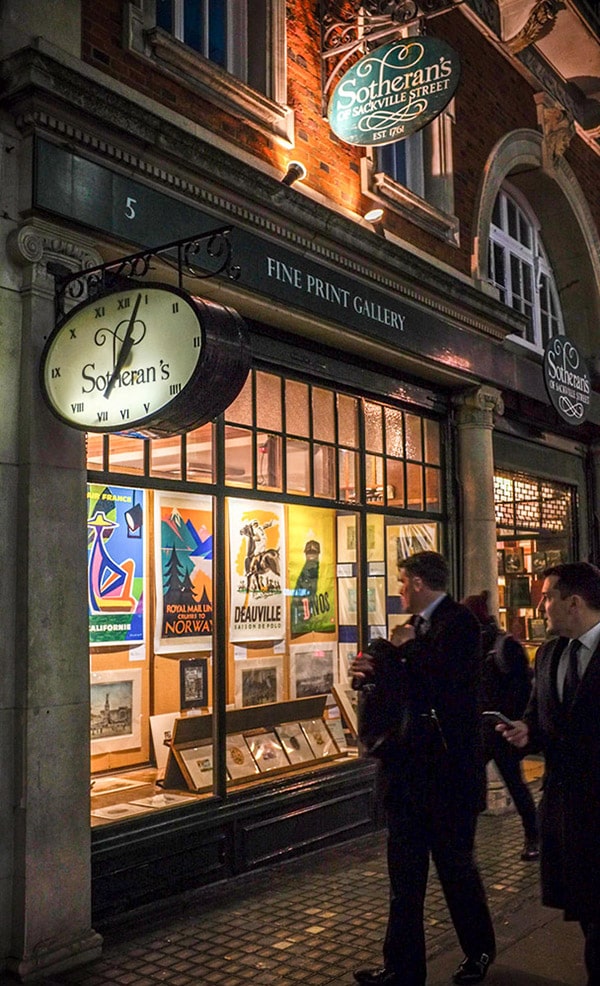
Founded in 1761, Sotheran’s in London is one of the oldest bookshops in the world. In this modern-day memoir, we follow the misadventures of an apprentice bookseller as he learns the rare book trade. The hard way.
At the bookshop, when 6-foot-tall Oliver Darkshire sits at his desk – a small, antique writing table designed for Victorian ladies – he has to sit “side-saddle” if he wants to sit at all. “It dawned on me that if I didn’t ask for something to do, my ossified remains might eventually be found cradling the tiny desk in my arms by a team of confused archaeologists.”
On Oliver’s journey as an apprentice, the reader learns along with him. It’s true that a rare book is valued on condition and scarcity. But a book in “good condition” isn’t good enough; it might as well be “on fire”. And if no one cares about the book? Even a hard-to-find book in fine condition won’t be valuable. Once Upon a Tome also offers safety tips for rare book collectors: Stay away from any bright green cloth bindings from the Victorian period. What makes the green color so bright? Arsenic. (Though a mystery writer might like that tidbit.) “The truth of the matter is…our shelves are filled with a great many fascinating and peculiar articles that go entirely unremarked on by visitors, unless we go to great effort to point them out.” 
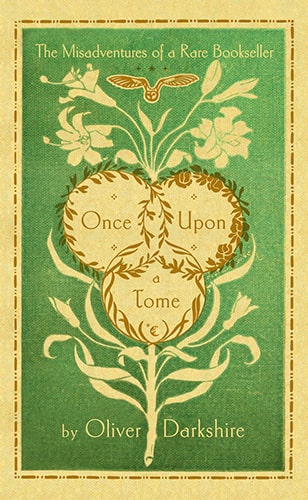
Once Upon a Tome’s title page in the style of a rare book.
There is so much detail in this tiny tome that you don’t want to miss. With the exception of the copyright page, be sure to read everything because there’s never a dull moment.
The author uses asterisks to indicate footnotes. Not scholarly footnotes, but usually a funny aside. I laughed a lot while reading this book. “The sheer amount of space required to house most book collections means that whoever shares your living area needs to be very understanding, or more ideally a co-conspirator, because the rest of their lives will be spent making room for your incredibly invasive pastime, until one day they trip on a folio and plummet to their doom down a staircase.” But there are also serious passages about bookshops as custodians of books. Rare books on topics such as the Holocaust or Africa can be saved from buyers who wish to destroy them by politely saying, “Oh, we lost the book.” or “It’s on reserve. My mistake.” “We are connected to the world by a thousand invisible strings, and each time we make sure a book gets to the right place…it’s a tiny step in the right direction.” When Oliver offers to help with the bookshop’s social media and shares stories about a suspicious gourd and a secret cellar, Sotheran’s following grows from four to more than a thousand (and now, more than 42,000). A rare accomplishment in the rare book world where email is considered a dark art. Despite his self-effacing humor, Oliver is optimistic about the future of booksellers. “There’s a hunger about book people…To follow a path so peculiar, with so few opportunities, and with no real prospects for wealth or prestige, I think you have to have a fickle relationship with rationality.” From cursed books and stuffed owls to book runners and health inspectors, I did not want this delightful book to end. I suspect we’ll be reading more from Oliver Darkshire. See more Books to Read: The Reader on the 6.27 No Time to Spare Read This for Inspiration Vivian Maier Developed Jane Austen: A Life 
Comments are closed.
|